A unified rights token is only half the story if it’s confined to a single chain. The whole point of building CCRMS as a Polkadot parachain rather than a single-chain application was to make content rights genuinely portable: a user should be able to acquire rights on one blockchain and use them on another without losing access or repurchasing them. This post explains how that works and where I had to draw an honest line between what’s proven and what’s merely designed.
Payer-Beneficiary Decoupling
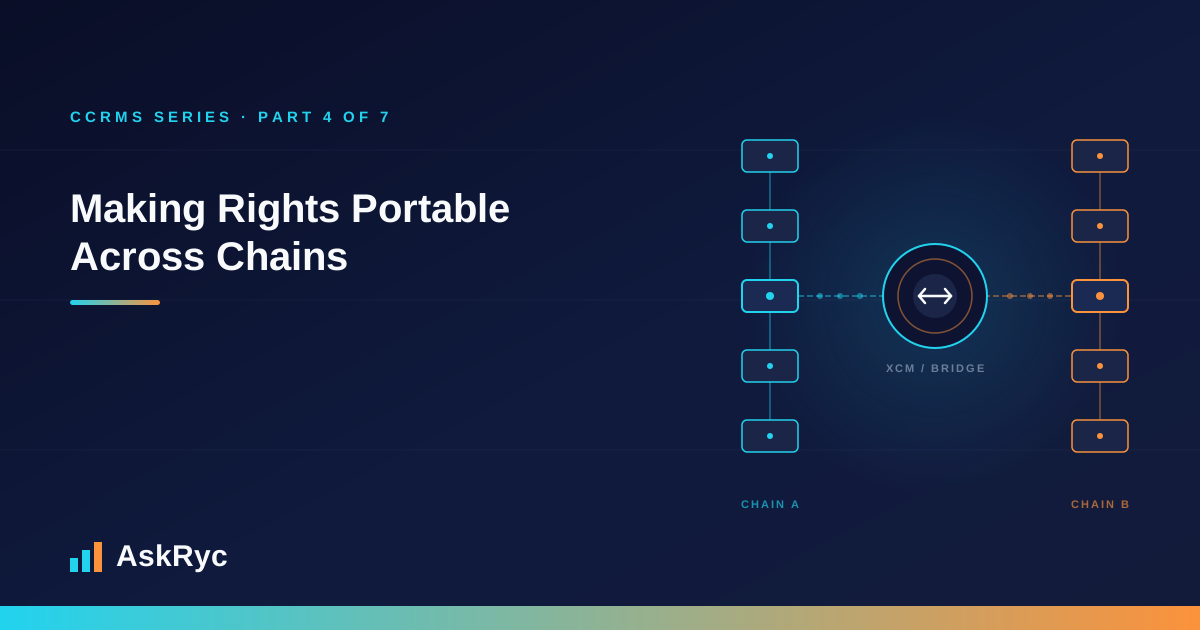
The mechanism is Polkadot’s Cross-Consensus Messaging protocol, XCM, and the core insight that makes cross-chain rights operations tractable is what I call payer-beneficiary decoupling. In a normal, single-chain transaction, the account paying for an operation and the account receiving its effects are the same — the caller. In a cross-chain call, that’s no longer true. When a remote parachain sends a message to CCRMS, the dispatch origin is the sovereign account of that remote chain, essentially a proxy address representing the entire parachain, while the actual beneficiary of the rights record is a separate, specific end-user account. That separation lets a remote parachain acquire rights on behalf of its users without those users ever needing to hold an account or interact directly with CCRMS.
Concretely, the pallet exposes five XCM extrinsics: xcm_subscribe, xcm_renew_subscription, xcm_purchase_views, xcm_purchase_ownership, and xcm_transfer_ownership. Each follows the same three-instruction message sequence: WithdrawAsset to withdraw the fee, BuyExecution to pay for the weight the operation consumes, and Transact to dispatch the extrinsic. This proved sufficient for every rights operation I needed to support, a meaningful finding in itself: no custom XCM extensions were required. XCM v3, used correctly, handles this class of problem out of the box.
Trustless Rights Verification
One question this raises immediately: if the rights record exists only on CCRMS, how does another parachain trust that a user holds an active subscription without running its own copy of CCRMS’s entire state? That’s what a second pallet, pallet-rights-verifier, is for. It provides trustless verification of CCRMS rights state via Merkle storage proofs. A remote parachain can submit a proof against a known CCRMS state root and — without any oracle or relayer in the loop — verify that a specific account holds an active subscription, an ownership record, or a remaining view-pack balance. Three extrinsics handle this: verify_ownership, verify_subscription, and verify_view_pack. Each constructs a storage key, validates the cryptographic proof, and emits a result event. The point is that CCRMS rights remain canonical on the CCRMS chain; other chains authenticate against that canonical state cryptographically rather than maintaining their own replicas.
The Latency Numbers
I measured end-to-end XCM latency for xcm_subscribe, xcm_purchase_views, and xcm_purchase_ownership at roughly 100 seconds of wall-clock time on my local test topology, which corresponds to a 3-to-5-block delta on the CCRMS chain. That block-count figure understates the actual elapsed time because the relay-chain hop and horizontal relay-routed message passing add about 70 seconds of wall-clock overhead that doesn’t appear in the CCRMS block count.
It’s worth being direct about this: that 100-second figure is a pre-Polkadot-2.0 upper bound, measured before the ecosystem’s Async Backing, Agile Coretime, and Elastic Scaling features matured. Those features materially reduce per-parachain latency, and I’d expect this number to drop significantly in a production Polkadot 2.0 environment. I’m reporting the number I actually measured, not the one I’d prefer to have measured, because that’s the only way this kind of result stays useful to anyone reading it later.
Snowbridge and Forward Compatibility
Another direction I pushed the cross-chain model was to move it entirely outside Polkadot and onto Ethereum via Snowbridge — a trust-minimized bridge that uses light-client verification on both sides rather than custodians or a trusted relayer. I successfully bridged two 1 ETH transactions from a local Ethereum chain to a local AssetHub parachain, running the complete pipeline: a Geth execution client, a Lodestar beacon node, sixteen Gateway contracts, and both a beacon relay and an execution relay forwarding proofs between the chains. Both transactions succeeded.
That demonstrates something I care about architecturally, which I call forward compatibility: I configured the CCRMS runtime’s location converters to accept Ethereum-originated XCM messages at minimal extra cost, well before I had any concrete plan to use bridged Ether. When I later wanted to explore paying for CCRMS operations with bridged Ether, the runtime was already prepared for it without touching the business logic pallet at all.
Honest Limits
I want to be honest about what the Snowbridge work demonstrates. The integration ran entirely on a local Ethereum stack, not on a public testnet or mainnet, so it’s a proof of architectural feasibility, not a validation of production bridge behavior under real network conditions, MEV, or beacon chain reorganizations. The final step — using bridged Ether to pay for a CCRMS rights operation end-to-end — was not implemented in the prototype. The XCM side is already configured to accept it; what’s missing is configuring the pallet’s payment currency to accept foreign Ether alongside the native token. That’s a small, well-scoped piece of near-term work, not a fundamental gap in the design.
The honest summary: XCM v3 is sufficient for authenticated, atomic cross-chain rights operations, with no custom protocol extensions required. The architecture is deliberately designed to extend to non-Polkadot ecosystems like Ethereum without changing the core business logic. The main caveat is latency, which is a toolchain-maturity issue, not an architectural one.
In the next post, I want to talk about everything that didn’t go as planned while I was building this — because that’s where the more interesting lessons live.
This is Part 3 of the CCRMS series. The full series walks through the architecture, engineering decisions, and honest results of building a cross-chain content rights system on Polkadot.